



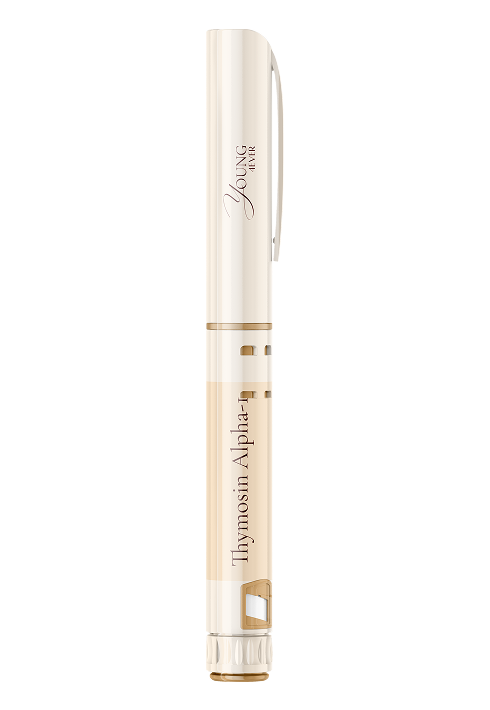
A More Balanced Approach to Immune Support
The immune system must perform two equally important tasks. It needs to respond effectively to genuine threats while avoiding excessive or poorly controlled activity that may place additional stress on healthy tissues.
Thymosin Alpha-1 supports immune regulation rather than indiscriminate stimulation. Its activity is connected with the maturation, differentiation, and coordination of several immune-cell populations involved in recognizing and responding to foreign antigens.
This regulatory profile distinguishes Thymosin Alpha-1 from basic immune-support products. The objective is not to make the immune response universally stronger, but to support a more organized and appropriate biological reaction.
Origin and Biological Role
Thymosin Alpha-1 is a naturally occurring 28-amino-acid peptide originally identified as a component of thymosin fraction 5. It is associated with the thymus, an organ that plays a central role in the development and education of T lymphocytes.
The thymus helps immune cells learn how to recognize foreign material while maintaining tolerance toward the body’s own tissues. Thymic activity is especially important during immune development, although it gradually changes with age.
By supporting pathways connected with thymic and T-cell function, Thymosin Alpha-1 has become relevant to immune restoration and age-management strategies. Its activity extends beyond one type of immune cell and influences communication between innate and adaptive immunity.
T-Cell Function and Adaptive Defense
T lymphocytes are responsible for identifying abnormal or infected cells and coordinating targeted immune responses. Different T-cell populations perform specialized functions, including direct cellular defense, immune memory, and regulation of other immune cells.
Thymosin Alpha-1 is associated with T-cell maturation and functional activity. It may support the biological environment required for T cells to recognize signals, communicate with other immune components, and participate in a measured response.
Adaptive immunity develops more slowly than the innate response but provides greater specificity. Supporting this part of the immune system is particularly relevant when resilience, recovery, and long-term immune readiness are the primary objectives.
Dendritic Cells and Antigen Recognition
Dendritic cells act as messengers between innate and adaptive immunity. They encounter foreign material, process it, and present relevant antigens to T cells so that a more specific response can develop.
Thymosin Alpha-1 is connected with dendritic-cell maturation and antigen-presentation pathways. This may help improve communication between the immune system’s rapid first response and its more targeted adaptive mechanisms.
Effective antigen presentation is essential because immune strength alone does not guarantee an appropriate response. The body must correctly identify the signal, activate the relevant cells, and regulate the intensity of the reaction.
Natural Killer Cell Activity
Natural killer cells belong to the innate immune system and provide rapid cellular surveillance. They help identify cells displaying unusual or stress-related signals without requiring the same antigen-specific recognition used by T lymphocytes.
Thymosin Alpha-1 is associated with pathways that support natural killer cell function and broader immune coordination. This contributes to its profile as an immune-modulating peptide rather than a compound acting on only one arm of immunity.
The combined influence on natural killer cells, dendritic cells, and T lymphocytes allows Thymosin Alpha-1 to support several stages of cellular defense. These stages include early recognition, immune communication, targeted response, and subsequent recovery.
The Thymosin Alpha-1 Difference
The defining characteristic of Thymosin Alpha-1 is precision. Its profile includes T-cell development, dendritic-cell maturation, natural killer cell activity, antigen presentation, cytokine balance, and communication between innate and adaptive immunity.
These mechanisms create a more comprehensive form of immune support than simply increasing inflammatory activity. A well-functioning immune system needs to recognize threats accurately, select an appropriate response, and return to balance after the challenge has passed.
Thymosin Alpha-1 is therefore positioned as an immune-modulating peptide for cellular defense, immune resilience, recovery, and healthy aging. Its primary value lies in regulation and coordination: not stronger immunity at any cost, but a more organized immune response.