NAD+ or NMN: What Is the Difference?
NAD+ and NMN are often mentioned together because both are closely connected to the same biochemical system. However, these compounds are not identical and perform different functions within the body.
NAD+ is a coenzyme that cells use directly in numerous biochemical reactions, including those involved in energy production.
NMN, or nicotinamide mononucleotide, is a precursor of NAD+. The body can use NMN as an intermediate compound in the natural process of producing NAD+.
The relationship between the two can be simplified as follows:
NMN → NAD+ → cellular energy and metabolic processes.
For this reason, NAD+ and NMN should not necessarily be viewed as direct competitors. They represent different stages within the same metabolic pathway.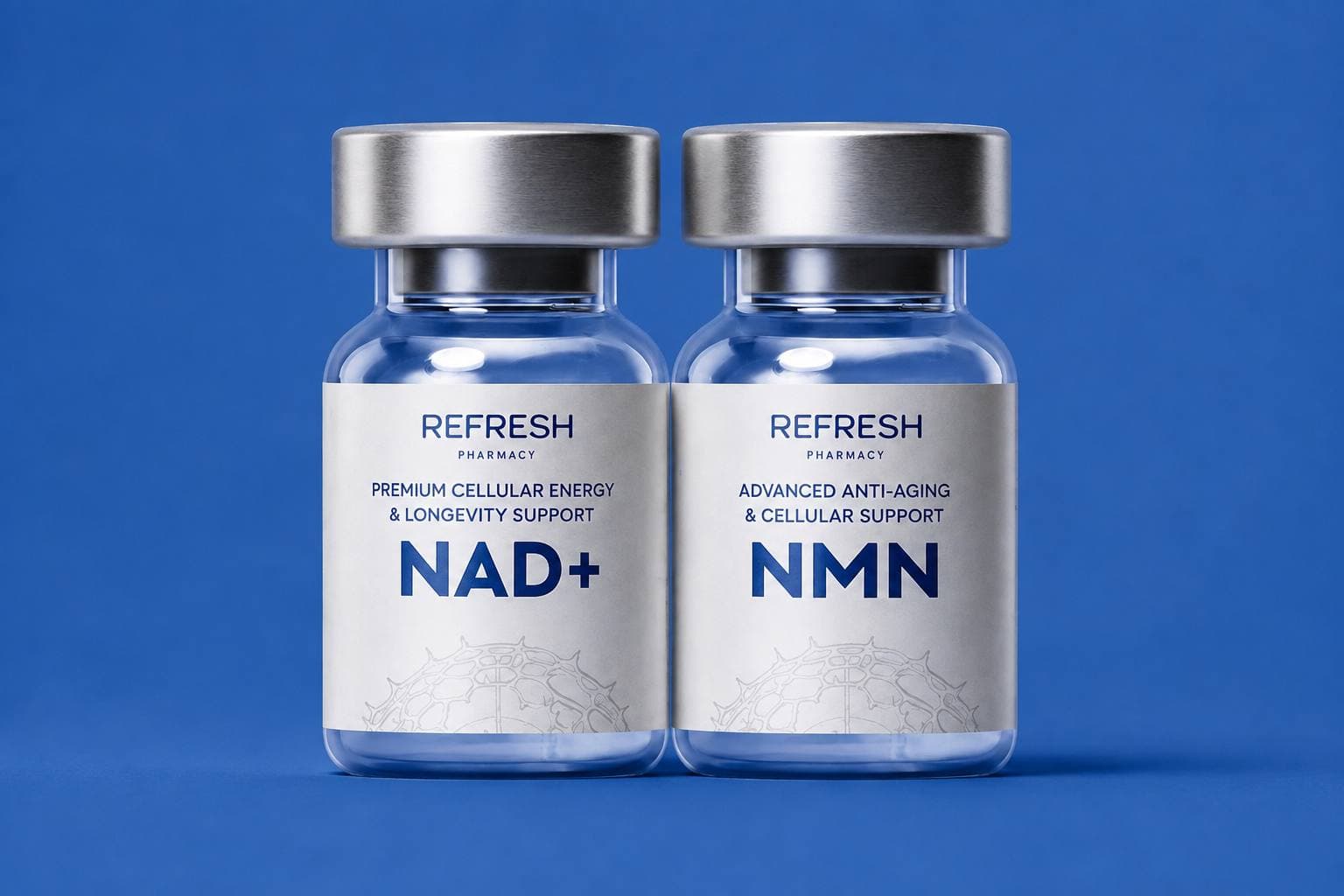

What Is NAD+?
NAD+ stands for nicotinamide adenine dinucleotide. It is a coenzyme found in cells throughout the body and is involved in a wide range of biochemical reactions.
One of its best-known functions is its role in cellular energy metabolism.
Nutrients such as carbohydrates and fatty acids need to undergo a series of chemical reactions before their stored energy can be used by cells. NAD+ participates in these reactions by transferring electrons between molecules and helping maintain normal redox processes.
This function is particularly important in mitochondria, the cellular structures responsible for a large part of ATP production.
However, the role of NAD+ goes far beyond energy metabolism.
NAD+ is also required for the activity of several NAD+-dependent enzymes. These enzymes are involved in metabolic regulation, cellular responses to various forms of stress, maintenance of cellular processes and mechanisms associated with DNA repair.
As a result, NAD+ is involved in several interconnected functions that are essential for normal cellular activity.
How Does NAD+ Work?
NAD+ continuously cycles between its oxidized and reduced forms inside cells.
During metabolic reactions, the molecule accepts and transfers electrons. This allows it to connect different stages of biochemical pathways and support the efficient flow of cellular metabolism.
NAD+ is involved in processes related to:
• cellular energy production;
• mitochondrial function;
• carbohydrate metabolism;
• fatty acid metabolism;
• enzymatic activity;
• normal cellular metabolism;
• mechanisms involved in DNA repair;
• cellular adaptation to metabolic stress.
In simple terms, NAD+ acts as an important component of the system that allows cells to obtain and use energy.What Is NMN?
NMN stands for nicotinamide mononucleotide. Unlike NAD+, it is not the final coenzyme directly used for the functions associated with NAD+.
Its main characteristic is that NMN acts as an intermediate compound in NAD+ biosynthesis.
Once NMN enters the body's metabolic pathways, it can be converted through a series of biochemical reactions. One of the resulting products is NAD+.
This explains one of the most important differences between the two compounds.
NMN does not perform all of the functions of NAD+ itself. Instead, it serves as a precursor that the body can use to produce NAD+.
Interest in NMN is therefore largely associated with its role in supporting the metabolic pathway responsible for maintaining NAD+ levels.
How Does NMN Work?
The body can produce NAD+ through several biochemical pathways. NMN participates in one of these pathways and is located relatively close to the final stage of NAD+ synthesis.
Once NMN is converted into NAD+, the resulting NAD+ molecule can take part in processes where the coenzyme is directly required.
These include cellular energy metabolism and the activity of NAD+-dependent enzymes.
The mechanism of NMN can therefore be described as providing a compound that the body can use for subsequent NAD+ production.
This is different from using NAD+ itself, where the product contains the already formed coenzyme.
Why Is NAD+ Important for Cellular Energy?
Cells need more than simply glucose, fatty acids or other nutrients to generate usable energy.
These substances must first pass through multiple biochemical reactions. NAD+ participates in several of these steps.
By accepting and transferring electrons, NAD+ helps maintain the flow of oxidation-reduction reactions involved in energy metabolism.
This function is particularly significant inside mitochondria.
Mitochondria contain a series of metabolic reactions that ultimately contribute to the production of ATP, the primary energy currency of cells. NAD+ is involved in several stages of this process.
For this reason, NAD+ is closely associated with cellular metabolism and energy production.
NAD+ and DNA-Related Processes
The functions of NAD+ are not limited to energy metabolism.
The molecule is also required by certain enzymes, including members of the PARP family. These enzymes participate in cellular mechanisms involved in detecting and responding to DNA damage.
NAD+ is used as part of the activity of these enzymes.
This means that the same coenzyme is involved in multiple cellular functions, ranging from energy metabolism to processes associated with maintaining cellular integrity.
This broad range of functions is one of the reasons NAD+ has an important place in cellular biology.
What Is the Main Difference Between NAD+ and NMN?
The key difference between NAD+ and NMN lies in their position within the biochemical pathway.
NAD+ is an active coenzyme that cells can use directly.
NMN is a precursor that can be converted by the body into NAD+.
Therefore, it would be inaccurate to simply describe one compound as stronger or better than the other. They are different molecules with different biological roles.
Their relationship can be represented in a simplified form:
NMN → NAD+ synthesis → NAD+ utilization by cells.
When NMN is used, the body needs to process it through the appropriate metabolic pathway before NAD+ is produced.
When NAD+ itself is used, the product contains the coenzyme in its already formed state.
NAD+ or NMN: Which One Should You Choose?
There is no universal answer to the question of whether NAD+ or NMN is better.
The appropriate option depends on the specific product, its formulation, concentration and route of administration.
NMN is used as a precursor within the metabolic pathway responsible for the body's production of NAD+.
NAD+ is the completed coenzyme that participates directly in cellular reactions.
When comparing products, it is therefore useful to look beyond the name of the active ingredient. The concentration, formulation, delivery method and characteristics of the particular product can also be important.
These factors may determine the practical differences between products containing NAD+ and those based on NMN.